I’ve been using AI in my work for a while now. At some point I noticed something that bothered me and wouldn’t go away: the outputs were getting better faster than my ability to judge them.
That’s not a hallucination problem. It’s a different problem, and I think it’s the more important one.
There is a particular kind of AI error that is much harder to catch than an obviously wrong answer.
It sounds right.
The grammar is good. The structure makes sense. The terminology is appropriate. The reasoning appears coherent. Nothing announces that a machine has made a mess of it. You read it once and think: yes, that sounds about right.
Then someone with deeper knowledge looks at it and says: no.
The problem isn’t that the output is nonsense. It may be factually correct in nearly every sentence. The problem is that it missed something an experienced practitioner would have noticed immediately — the failure condition the test case never covered, the real concern behind the customer’s polite objection, the organisational history that makes the announcement land badly.
The output is not necessarily bad. It is simply not good enough.
Which raises the question I haven’t been able to stop thinking about:
How do we know when something is wrong if we have never learned what right looks like?
For generations, professional work did two things at once.
It produced the artifact. And it produced the practitioner.
I learned to write by writing badly and having someone tell me why. That’s how most of us learned anything worth knowing at work — by doing it wrong first, with consequences, and figuring out what we’d missed. The task wasn’t just producing something. It was becoming someone who could produce it better next time.
AI changes that relationship. AI can increasingly produce the artifact without producing the practitioner. The output arrives. The learning may not.
The machine has removed the friction. But some friction was the curriculum.
This isn’t an argument against using AI. It’s a question about what we’re accidentally automating alongside the work. When a junior communicator never wrestles with an awkward internal announcement, they may become a better editor without becoming a better communicator. When a junior engineer’s first task is to ask AI to explain existing code rather than to read it, break it, and fix it, they skip the cognitive struggle that builds mental models. When a junior marketer generates ten campaign concepts before learning why the first campaign failed, they’re acquiring speed without understanding.
The apprenticeship problem isn’t that beginners use AI. It’s that they may use AI before they’ve accumulated enough experience to recognise what the machine has missed.
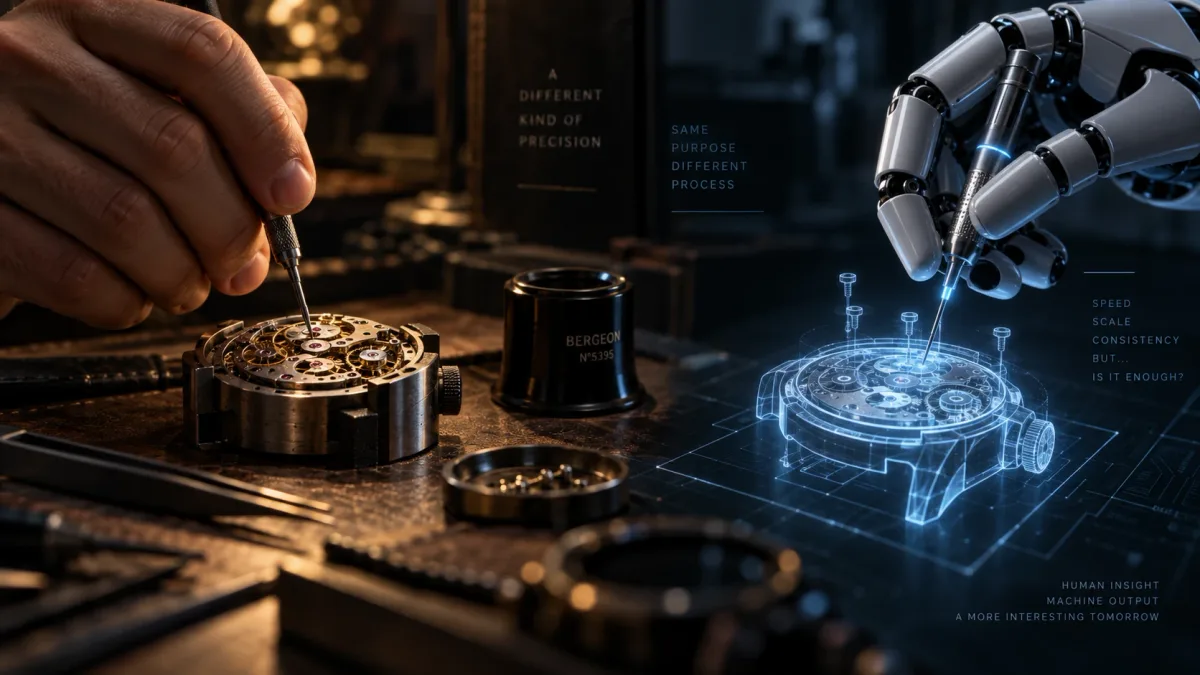
An experienced practitioner and a novice can enter the same prompt into the same model and receive the same output. They do not receive the same value.
The expert brings a mental model. The novice brings only a request. The expert sees a suspicious assumption. The novice sees a useful answer. The expert asks why. The novice asks what next.
A 2026 field experiment involving 758 BCG consultants found that AI improved performance substantially on tasks within its capability frontier — but on a complex managerial task outside that frontier, participants using AI were 19 percent less likely to produce a correct solution. The novices could produce better-looking outputs but were less able to recognise when the task framing was wrong.
Saying “AI is just a tool” misses this. A tool changes what a person can do. It can also change what a person learns to do.
None of this requires AI to produce spectacularly wrong information.
The API documentation is mostly correct. The code works. The sales email is professional. The announcement is empathetic. The strategy is coherent.
The problem is what I’ve started calling plausible mediocrity: the output clears the threshold of looks good without reaching the threshold of has been understood.
Obvious errors trigger correction. Plausible mediocrity creates acceptance. The real danger is quieter than a wrong answer. It’s an organisation that stops being able to tell the difference. The bar drops a little. Nobody announces it. The new normal just becomes normal.
“Keep a human in the loop” sounds reassuring. But there’s a difference between:
- Human presence — someone looked at the output
- Human editing — someone changed the output
- Human review — someone checked it against a requirement
- Human judgment — someone understood enough to recognise what was missing
Only the last one protects you. A human can review something they don’t understand. That’s not oversight. That’s attendance.
So what do we actually do?
Not this: preserve manual work because manual work is virtuous. That misses the point entirely.
This: Automate execution. Protect understanding.
If AI can format the table, let it format the table. If it can summarise documents, generate boilerplate, produce first drafts — use those capabilities without apology.
But before delegating anything that matters, ask: what was this task supposed to teach the person doing it? If the answer is nothing beyond mechanical execution, automate it. If the answer includes judgment, domain knowledge, or consequence awareness, redesign the workflow so the learning survives even when the execution is automated.
And consider using AI as a comparative adversary rather than a surrogate author. Try the problem yourself first. Then ask AI to solve it. Compare the two. Where did it see something you missed? Where did you understand something it missed? The disagreement becomes the curriculum.
I wrote a longer version of this argument — with research citations, five detailed domain scenarios, and a seven-question framework called the Assume Nothing Test — and published it on Substack.
I used AI to help write it. That’s not a contradiction. The question was never whether to use AI. It was what to delegate, what to retain, and what to understand myself.
I read every line before I published it. That’s not virtue. That’s the minimum.
The machine is doing it. Let it.
Just don’t let it do the learning too.
Read the full paper on Substack → parthans.substack.com